
CASE STUDY: Optimizing Institutional Effectiveness Through Systemic Wellbeing at San Diego Miramar College
Author: Nadine Wilches, LCSW | Chief Behavioral Scientist, MindArch Health
June, 2026
Executive Summary
Institutional effectiveness (IE) in higher education has evolved into a multi-dimensional, evidence-based system linking strategy and learning outcomes to equity-oriented indicators. San Diego Miramar College, an AANHPI and HSI designated institution serving 13,500 students, recognized that traditional "crisis-response" mental health models were insufficient for a "time-poor" commuter population. By implementing the EQUIP Model and the 5-Elements of Systemic Wellbeing Framework via MindArch Health Automation Pathway (MAP) software, the institution transitioned to a proactive prevention strategy. This approach identified root-cause vulnerabilities and drove measurable institutional change while optimizing limited personnel and financial resources.
The Methodology: The EQUIP Model & MAP Software
The EQUIP Model is a socioecological framework that recognizes human health is shaped by the interplay of individual, social, and environmental factors. The implementation followed five iterative phases within the MindArch Health Automation Pathway (MAP) Software:
Examine Vulnerabilities (E): Analyzing Social Determinants of Health (SDOH) and regional environmental stressors.
Quantify Mental Wellbeing (Q): Benchmarking population resilience and internal protective factors using evidence-based metrics.
Unite Community (U): Forming a multi-sector stakeholder task force to foster shared responsibility.
Inquire Diverse Perspectives (I): Using AI-assisted appreciative inquiry to gather qualitative narratives and identify community strengths.
Plan Protective Solutions (P): Co-designing "4P" solutions (Policies, Practices, Programs, and Places) tailored to the campus culture.
Phase 1: Identifying Regional Risk (Examine)
The MAP software identified high-risk factors for the San Diego community by scraping regional datasets and comparing them to national averages.
Household Functioning: San Diego County faces higher-than-average housing insecurity at 13.8% compared to the 12.9% national average.
Social Support: A lack of social and emotional support was identified in 28.6% of adults in the county, significantly higher than the 25.7% national average.
Institutional Constraints: Contextual analysis highlighted that insufficient state funding and a lack of physical space were major structural hurdles to expanding support services.
Phase 2: Benchmarking Wellbeing (Quantify)
Baseline assessments (n=304) moved the focus from pathology to flourishing by quantifying the presence of protective conditions.
Current Status: The student population was benchmarked as 68% Mentally Healthy and 69% Stress Resilient.
Demographic Insights: The respondent pool was approximately 59% Women and 34.3% Man. Racial representation included 34.7% White, 34% Asian, and 20.7% categorized as another race.
Predictive Goal: MAP identified the primary opportunity for systemic improvement:
"Increase Relatability by improving Personal Empowerment"
Phase 3: Data to Action (Unite & Inquire)
Miramar formed a task force including Student Affairs leadership, mental health clinicians, and basic needs coordinators.
Efficiency: MAP’s AI-assisted summarization analyzed qualitative stakeholder narratives, saving significant personnel hours typically required for thematic analysis.
Key Insight: Qualitative inquiry revealed that the Basic Needs and Counseling departments were the most "highly-trusted hubs of empowerment" on campus.
Phase 4: Targeted 4P Interventions (Plan)
The strategic plan co-designed four pillars of systemic change aimed at addressing personal empowerment and relatability:
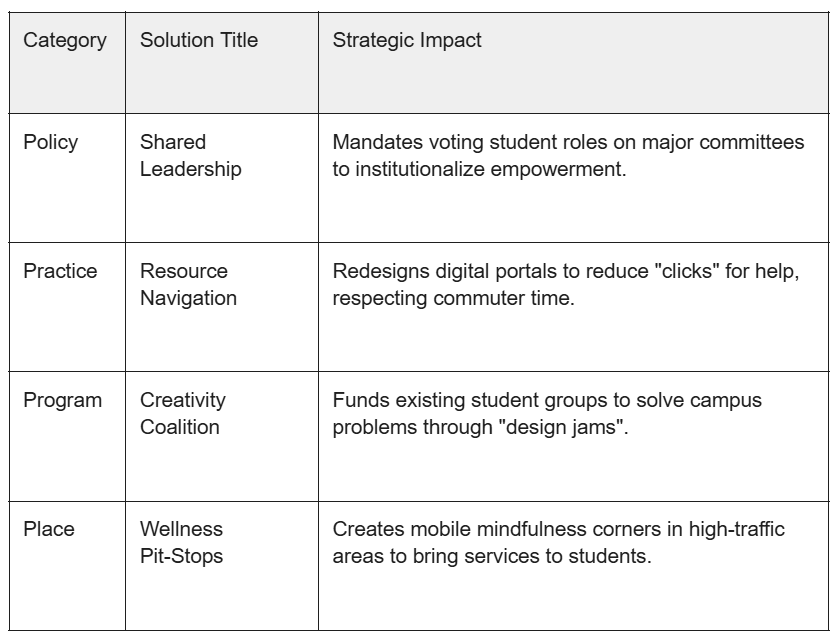
MindArch Health MAP Targeted 4P Interventions (Plan) for Miramar College of San Diego 2024-2025
Institutional Outcomes and Impact
Post-intervention remeasurement proved that embedding wellbeing responsibility across systems is more effective than siloed clinical care:
Observable Growth: Student empowerment was observed and reported by students through newly created institutional roles, co-design of systemic solutions including health promoting, inclusive, wellness connection spaces.
Sustainability: Findings shifted the priorities for a county grant renewal with the San Diego Foundation, adding requirements for intentional collaboration and referral pathways for all recipients.
Engagement: The Collective Creativity Coalition's "Community Circle" grew from 2 to 15 participants in two months, sustaining that impact weekly for 6 months, reaching over 200 unique students, fostering deep, engaged sharing.
Operational Efficiency: Automated analytics reduced the need for external consultants, allowing leadership to present actionable data directly to stakeholders.
Continuous Improvement
Miramar College is committed to the continuous, campus-wide application of the EQUIP Model to strengthen student mental wellbeing and drive improvements in academic, lifestyle, and achievement outcomes. Given the rapid change in needs and experiences of a two-year institution's student population, utilizing data science for quick, informed decisions based on precise population needs and proven indicators of success remains critical.
