
Preventing Teen Dating Violence: A Comprehensive Proactive Population Health Framework
Author: Nadine Wilches
February, 2026
The traditional landscape of public health and behavioral health has long been defined by its responsiveness to crisis. When an adolescent experiences physical or sexual harm within a dating relationship, the machinery of the social service and healthcare sectors activates to provide triage, treatment, and recovery. While these services are indispensable for those already harmed, they represent the final stage of a systemic failure to intervene before the onset of violence. Teen dating violence (TDV), a significant public health issue affecting millions of young people annually, is an adverse childhood experience (ACE) with lifelong implications for health, economic opportunity, and overall wellbeing (Basile et al., 2020). To address this challenge, a fundamental shift is required: emphasizing resources not just on reactive, deficit-based models but on proactive, preventive, and systemic approaches grounded in population health informatics and the principles of positive psychology (Wilches, 2022).
This report explores the architectural requirements for such a shift, synthesizing evidence-based frameworks such as the 5-Elements of Systemic Wellbeing and the EQUIP model to design environments that inherently buffer against violence and promote human flourishing. By leveraging advanced data analytics and the socioecological model, a framework that looks at how individuals are influenced by their relationships, communities, and society, communities can move "upstream" to identify and mitigate risks before they manifest as trauma (Niolon et al., 2019; Wilches et al., 2025).
The Epidemiology and Impact of Teen Dating Violence
Teen dating violence is a multi-dimensional problem that includes physical violence, sexual violence, psychological aggression, and stalking, occurring both in person and through digital technology (Basile et al., 2020; Hossain et al., 2020). Data from the 2021 Youth Risk Behavior Survey highlights the alarming prevalence of these experiences among U.S. high school students (Basile et al., 2020).
Type of Dating Violence
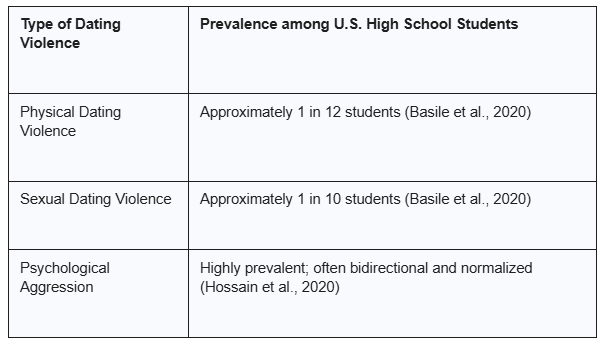
MindArch Health Inc. 2026 _ Teen Dating Violence Prevalence
The consequences of TDV are not limited to immediate physical injury. The experience of violence in adolescence sets a trajectory for future relationship problems, including intimate partner violence (IPV) perpetration and victimization in adulthood (Basile et al., 2020). Furthermore, victims are significantly more likely to experience symptoms of depression and anxiety, engage in unhealthy behaviors such as substance use, exhibit antisocial behaviors, and experience suicidal ideation (Basile et al., 2020; Hossain et al., 2020).
The societal cost of unaddressed mental health challenges and interpersonal violence is staggering. For instance, untreated mental illness was associated with approximately $4.2 billion in societal costs in a single state, Indiana, in 2019 (Sheridan, 2025). These costs reflect workforce losses, the strain on the criminal justice system, and the co-occurrence of chronic physical conditions that stem from prolonged stress exposure (Sheridan, 2025). Consequently, the prevention of TDV is not only a moral imperative but a critical economic strategy for community stability.
Theoretical Foundations: Moving Upstream
To effectively prevent TDV, we must adopt a prevention science perspective that distinguishes between different levels of intervention. Primary prevention aims to stop violence before it ever happens by addressing root causes and strengthening protective factors (Malherbe et al., 2025). Secondary prevention involves early detection and screening to minimize the impact of early-stage violence, while tertiary prevention focuses on rehabilitation after harm has occurred (Malherbe et al., 2025).
The Socioecological Model (SEM)
The socioecological model (SEM) provides the necessary lens for understanding that violence is not solely the result of individual choice, but the outcome of a complex interplay between four distinct levels (Malherbe et al., 2025; Ribeiro et al., 2024):
Individual Level: Factors include personal attitudes, history of maltreatment, and internal psychological states, such as emotional regulation and self-esteem (Basile et al., 2020; Ribeiro et al., 2024).
Relationship Level: Focuses on the immediate social circle, including peers, family members, and dating partners, where patterns of power and control are first established (Basile et al., 2020; Ribeiro et al., 2024).
Community Level: Examines the settings in which social relationships occur, such as schools and neighborhoods (Malherbe et al., 2025).
Societal Level: Encompasses broad social and cultural norms that create a climate in which violence is either encouraged or inhibited, such as patriarchal beliefs or gender-based inequities (Hossain et al., 2020; Ribeiro et al., 2024).
A proactive approach requires implementing strategies across all levels of the SEM simultaneously (Malherbe et al., 2025). Focusing only on individual skill-building without addressing the community environment or societal norms is likely to produce limited, short-term results.
Positive Mental Health (PMH) and Flourishing
A critical insight from recent research is that mental health is more than the absence of illness; it is a distinct construct known as positive mental health (PMH), encompassing wellbeing, flourishing, and resilience (Wilches et al., 2025). In the Wellbeing Framework Study, conducted by MindArch Health, the role of preventative care in mental health was explored by examining factors that sustain wellbeing through the lens of internal and external protective factors (Wilches et al., 2025).
The study indicates that high levels of PMH can buffer the negative impacts of stress and are predictive of recovery from mental health conditions (Wilches et al., 2025). By incorporating measures of PMH into population health surveys, practitioners can move beyond a deficit-based approach, where the goal is merely to reduce "symptoms", to a flourishing-based approach, where the goal is to build the capacities that prevent the "dis-ease" from occurring in the first place (Hu, 2025; Wilches et al., 2025).
The 5-Elements of Systemic Wellbeing Framework
The 5-Elements of Systemic Wellbeing Framework serves as a data-driven blueprint for architecting systemic health (Wilches, 2022). Derived from a reflexive thematic analysis of over 2,000 research studies, this model identifies five central themes, Secure, Regulated, Valued, Decided, and Related, that are essential for both individual flourishing and environmental resilience (Wilches, 2023; Wilches, 2022).
Each of the five elements is divided into 12 subfactors: six internal (personal psychological capacities) and six external (environmental protective factors) (Wilches, 2023). This creates a total of 60 data points that can be quantified to assess the health of a population (Wilches et al., 2025).
Five Elements in the Context of Teen Dating Violence
1. Secure: The Foundation of Safety
The "Secure" element addresses the fundamental need for safety and social justice. Internally, it involves a young person’s sense of safety and their belief that they are protected from harm; externally, it requires an environment characterized by physical safety, economic security, and equitable access to resources (Wilches, 2022). For a victim, a lack of security (e.g., housing instability) makes them more susceptible to "intimate terrorism," where a partner uses their vulnerability as a tool for control (Malherbe et al., 2025; MindArch Health, 2024). For a perpetrator, their own lack of perceived security, often resulting from witnessing family violence or facing systemic instability, can drive a distorted need to dominate others to reclaim a sense of personal safety (Basile et al., 2020; Ribeiro et al., 2024). Systemic solutions focus on providing equitable access to resources and physical safety across community settings to remove the vulnerabilities that sustain these cycles.
2. Regulated: The Mechanism of Stability
Internal regulation refers to the ability to manage intense emotions and cope effectively without resorting to aggression (Basile et al., 2020). Victims of violence often experience hyper- or hypo-arousal as a direct result of interpersonal trauma and may struggle to regulate their emotional responses effectively. For perpetrators, a lack of regulation is a primary risk driver; hostility and poor impulse control are among the strongest predictors for physical TDV perpetration (Cohen et al., 2025). Systemic prevention includes universal skills training in emotional regulation and the implementation of predictable, trauma-informed school and community policies to help youth manage "big feelings" without force (Niolon et al., 2024).
3. Valued: The Recognition of Worth
Being "Valued" involves a sense of internal self-worth and external recognition. Adolescents who feel undervalued by their community are more susceptible to grooming behaviors and psychological coercion from partners offering a false sense of being "special" (Ribeiro et al., 2024). Conversely, potential perpetrators often seek validation through dominance, attempting to achieve status among peer groups that normalize violence as a means of recognition (Reyes et al., 2018). Systemic prevention involves shifting cultural and peer norms to ensure all youth feel they "matter" for their intrinsic worth, thereby buffering against the drive for toxic, dominance-based validation (MindArch Health, 2024).
4. Decided: The Power of Autonomy
The "Decided" element pertains to agency, purpose, and the capacity to make meaningful choices (Wilches, 2022). In TDV, "coercive control" directly attacks this element by stripping a victim of decision-making power through constant digital monitoring of texts and social media (Hossain et al., 2020; Basile et al., 2020). For the perpetrator, the drive to control often stems from adherence to rigid gender scripts or a personal lack of agency in other areas of life (Adhia et al., 2023). Systemic prevention focuses on empowering all youth with decision-making skills and strengthening legal and institutional supports that protect individual autonomy and boundaries (Exner-Cortens et al., 2025).
5. Related: The Strength of Connection
"Related" focuses on social connections, community integration, and healthy problem-solving (Wilches, 2023). For victims, social exclusion—particularly among LGBTQ+ students—increases vulnerability as they lack the social "buffers" needed to resist harm (Basile et al., 2020). However, perpetrators are often deeply influenced by peer ties that normalize aggression or reinforce harmful masculinity (Reyes et al., 2018). Systemic prevention involves strengthening family and peer networks to teach empathy and provide the supportive connection needed to prevent violent patterns from forming (Niolon et al., 2024).
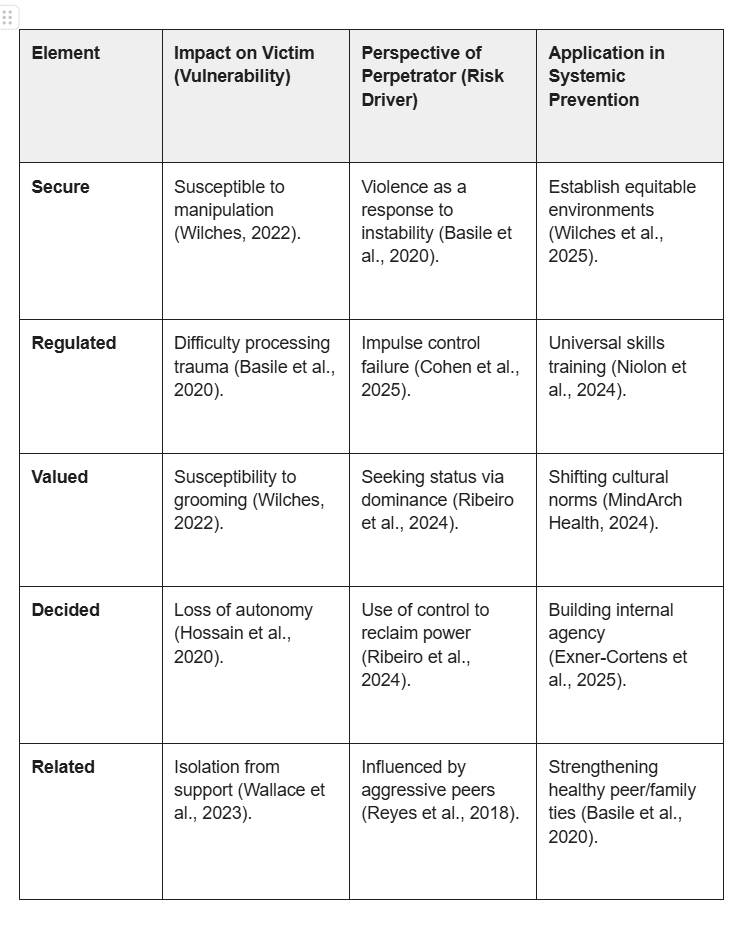
MindArch Health 5-Elements of Systemic Wellbeing Framework in relationship to Teen Dating Violence
Population Health Informatics and Predictive Analytics
The transition from reactive to proactive health models can be fueled by population health informatics: the use of data automation, machine learning, and predictive modeling to identify risks and automate strategic plans (Wilches, 2023). Rather than waiting for a crisis to appear, informatics allows us to "architect" tailored and comprehensive solutions by identifying unique community vulnerabilities in advance (Wilches, 2023).
The MindArchHealth Automation Pathway (MAP)
MindArch Health launched the MAP software to enable institutions to shift from reactive to proactive planning (Wilches, 2023). By leveraging predictive analytics, AI, and machine learning, MAP facilitates a structured assessment and intervention process, allowing for "Automated Scoring & Reporting" that identifies the most protective solutions for a given population (Wilches, 2023).
Strategic use of MAP includes:
Predictive Modeling: Identifying specific populations or areas within a system that are at high risk (Wilches, 2023).
Protective Factor Assessment: Quantifying the presence of the 5-Elements of Systemic Wellbeing to determine resilience (Wilches, 2023).
Monitoring: Enabling foundations to monitor progress to maximize positive impact, support resource allocation, and allow for early "course correction" (Wilches, 2023).
The Role of Artificial Intelligence in Risk Detection
Current research is exploring the use of AI to detect individuals at risk of perpetrating family or dating violence using textual or voice signal data (Hossain et al., 2020). For instance, vocal pitch and articulation patterns can distinguish between distressed and non-distressed individuals, while AI models can analyze clinical notes to identify linguistic markers of violence risk (Hossain et al., 2020).
Predictive analytics in youth justice often uses tools like the Structured Assessment of Violence Risk in Youth (SAVRY), which reports accuracy values (AUC) ranging from 0.54 to 0.84 (Ribeiro et al., 2024). However, an "Innovation Gap" persists. Many health tech developments fail to address tangible healthcare problems if they do not account for real-world risks and provider stress (Wilches, 2023).
Systems-Change Methodology: The EQUIP Model
To move from data to action, MindArch Health employs the EQUIP model, a five-step iterative process for communities to transition from reactive treatment to proactive flourishing.
Phase 1: Examine (Social and Structural Vulnerabilities)
This phase involves identifying the "upstream" causes of violence, such as economic inequity and systemic biases (Wilches, 2023; Wilches, 2022). By acting on causes rather than treating symptoms, systems provide better outcomes for all children (Basile et al., 2020).
Phase 2: Quantify (Measuring Population Wellbeing)
Using the 5-Elements Framework, the "Quantify" phase provides a multi-dimensional assessment of a population's health (Wilches, 2023). This goes beyond counting cases of dating violence to measuring the underlying levels of security and regulation that prevent those cases from occurring.
Phase 3: Unite (Diverse Task Force)
Change requires collective effort. The "Unite" phase involves forming a task force of diverse stakeholders, including those with lived experience to ensure that interventions are inclusive and reflect the perspectives of the community (Wilches, 2023).
Phase 4: Inquire (Appreciative Inquiry into Local Context)
Instead of a traditional "gap analysis" that only looks at what is missing, "Inquire" identifies local strengths and existing protective factors (Wilches, 2023). This builds on existing successes to architect environments that buffer stress (Wilches, 2023).
Phase 5: Plan (Scaffolded Action Plan)
The final phase is the creation of a participatory action plan that is "scaffolded", providing the necessary support for effective implementation (Wilches, 2023). This plan is managed through the MAP software to ensure data-centric decision-making (Wilches, 2023).
Implementing Proportionate Universalism
A central challenge in public health is determining how to allocate resources. Proportionate universalism (also known as "blended prevention") suggests that actions must be universal, but their scale and intensity must be proportionate to the level of disadvantage (Ribeiro et al., 2024; Basile et al., 2020).
A multilevel system like the Dating Matters comprehensive model exemplifies this approach. It produced larger and longer-lasting reductions in TDV, roughly 19-24%, than a single curriculum alone, with effects persisting into high school (Niolon et al., 2019; Niolon et al., 2024). This suggests that school districts should offer universal healthy relationship education while providing more intensive support for youth identified (e.g. through the "Quantify" phase) as having high risk (Cohen et al., 2025; Niolon et al., 2024).
Ethical Considerations: AI and the "Innovation Gap"
As we integrate AI into prevention strategies, we must address the "Innovation Gap" (MindArch Health, 2024). Predictive analytics can lead to "systematic errors," such as overestimating risk for low-scoring youth, which can lead to unnecessary intervention and stigma (Ribeiro et al., 2024). Effective informatics must be integrated with behavioral science experts to ensure that data insights lead to sustainable, human-centered action (MindArch Health, 2024).
Conclusion: Shifting the Paradigm
The prevention of teen dating violence requires an architectural shift: moving toward "architecting comprehensive psychological health solutions" that are proactive and data-driven (Wilches, 2023). By using the 5-Elements of Systemic Wellbeing Framework and the EQUIP model, we can transition from a focus on disorders to a focus on flourishing (Wilches, 2023; Wilches, 2022). Through the integration of population health informatics and socioecological strategies, we can ensure that every young person has the security, regulation, value, decision, and connection they need to thrive.
References
Basile, K. C., et al. (2020). Youth risk behavior surveillance — United States, 2019. Centers for Disease Control and Prevention.https://www.cdc.gov/yrbs
Cohen, J., Choi, J., Fishbach, J., & Temple, J. (2025). A trauma-focused screening approach for teen dating violence prevention. Prevention Science, 26, 80–92.https://doi.org/10.1007/s11121-025-01772-4
Exner-Cortens, D., Sharma, S., & Craig, W. (2025). Research on law and policy to prevent teen dating violence: Scoping review. Trauma, Violence & Abuse.https://doi.org/10.1177/15248380251320994
Sheridan, E. (2025). The rippling impact of unaddressed mental health: A societal burden. MindArch Health.https://www.mindarchhealth.com/articles
Hossain, M., Sultana, A., Fan, Q., Ma, P., & Purohit, N. (2020). Prevalence and determinants of dating violence: An umbrella review of systematic reviews and meta-analyses. Advance.https://doi.org/10.31124/advance.11492703
Hu, C. (2025). The Mental Health Crisis: Are We Treating the Disease, or the Dis-Ease? MindArch Health.https://www.mindarchhealth.com/articles
Malherbe, I., Kacenelenbogen, N., & Briganti, G. (2025). Prevention in teen dating violence: An overview. Psychiatria Danubina, 37(Suppl 1), 91–98.
MindArch Health. (2024, September 6). MAP software launch version 1.0.0.https://www.mindarchhealth.com/articles
Niolon, P. H., et al. (2019). An RCT of Dating Matters: Effects on teen dating violence and relationship behaviors. American Journal of Preventive Medicine, 57(1), 13–23.https://doi.org/10.1016/j.amepre.2019.02.022
Niolon, P. H., et al. (2024). High school follow-up of the Dating Matters® RCT: Effects on teen dating violence and relationship behaviors. Prevention Science, 25, 603–615.https://doi.org/10.1007/s11121-024-01648-z
Piolanti, A., & Foran, H. (2021). Efficacy of interventions to prevent physical and sexual dating violence among adolescents: A systematic review and meta-analysis. JAMA Pediatrics, 176(1), 1–8.https://doi.org/10.1001/jamapediatrics.2021.4829
Ribeiro, N. Q., et al. (2024). Prevalence and factors associated with the perpetration and victimization of teen dating violence: A systematic review and meta-analysis protocol. MethodsX, 13, 103003.https://doi.org/10.1016/j.mex.2024.103003
Wilches, N. (2022). Fostering flourishing: Applying the 5-elements of systemic wellbeing framework to mitigate adjustment disorder in college students. MindArch Health.https://www.mindarchhealth.com/articles
Wilches, N. (2023). The EQUIP Model: A Socioecological Framework for Applied Preventive Mental Health. https://www.mindarchhealth.com/articles/1onqvv0qdicwvtun8s55un4l72rxd6
Wilches, N., Dominguez, G., & Khan, M. (2025). Wellbeing framework study: Protective factors and mental health. MindArch Health.https://www.mindarchhealth.com/articles
