
RESEARCH | CASE STUDIES| STRATEGIES AND SOLUTIONS
Apply the latest research to strengthen mental wellbeing and prevent stress-related disorders in your communities.
Chief Editor: Nadine Wilches, LCSW
All Articles
V

Multi-Systemic Psychosocial Supports for Pediatric and Young Adult Cancer Survivors: A Literature Review
Long-term survival rates for childhood cancer have increased dramatically over the past few decades, with 5-year relative survival rates now exceeding 85% in high-income countries (Erdmann et al., 2021). While these medical advancements are noteworthy, the intensive nature of treatments like chemotherapy, radiation, surgery, and prolonged periods of isolation leaves profound emotional and physical marks on young survivors.
Pediatric cancer survivors (PCS) frequently face a complex mix of long-term health challenges after treatment. These issues include body transformations, physical side effects, severe loneliness, and noticeable neurocognitive difficulties, such as problems with memory, concentration, and planning daily tasks (Crochet et al., 2019; Low et al., 2024; O'Donnell et al., 2025). During active pediatric cancer treatment, multidisciplinary teams routinely provide structured psychosocial support to help families manage acute distress (Scialla et al., 2018).
However, as patients transition into remission, scheduled contact with oncology teams decreases, which can leave families with reduced immediate access to ongoing support (Ryan et al., 2021). While basic support is common during active treatment, many pediatric oncology programs lack the specialized mental health staff required to meet recommended long-term standards of care, leaving many survivors with unaddressed psychosocial needs (Lown et al., 2015; Scialla et al., 2018).
To ensure optimal long-term health outcomes, institutions require reliable, scalable programs that connect acute hospital treatments to homelife (Coleman et al., 2006; Naylor et al., 2004). This literature review evaluates the stress and emotional challenges faced by childhood cancer survivors and explores how A Moment of Magic (AMoM) may be able to address these gaps through their scalable, community-led volunteer model. By analyzing current mental health program outcomes, family dynamics, and systemic hospital staffing shortages, this paper investigates how integrating AMoM's framework with the 5-Elements of Systemic Wellbeing Framework assessments, measuring psychological health and stress resiliency, can deliver affordable, preventative care early in the survivorship continuum.
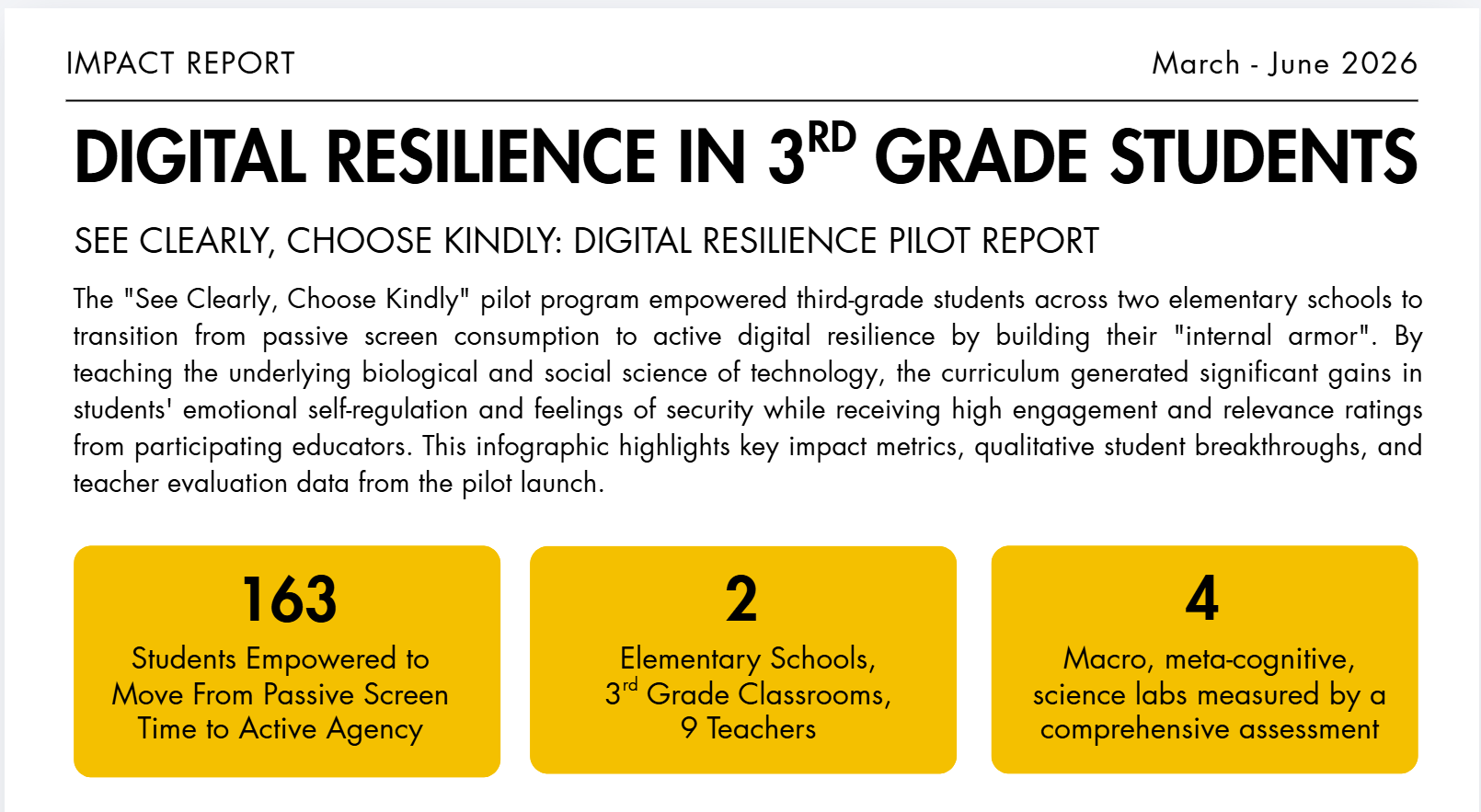
Digital Resilience in 3rd Grade Students: Impact Report
The "See Clearly, Choose Kindly" pilot program empowered third-grade students across two elementary schools to transition from passive screen consumption to active digital resilience by building their "internal armor". By teaching the underlying biological and social science of technology, the curriculum generated significant gains in students' emotional self-regulation and feelings of security while receiving high engagement and relevance ratings from participating educators. This infographic highlights key impact metrics, qualitative student breakthroughs, and teacher evaluation data from the pilot launch.
The Paradox of Risk: A Systemic Evaluation of AANHPI Mental Wellbeing, Stress Resiliency, and Vulnerability in San Diego County with Miramar College
This applied research report, offers a comprehensive examination of the psychological landscape characterizing the Asian American, Native Hawaiian, and Pacific Islander (AANHPI) population in San Diego County. Commissioned to contextualize the findings of recent evaluations at San Diego Miramar College and to support the strategic objectives of the San Diego Foundation, this document investigates a critical public health anomaly: the "Paradox of Risk."
Our central thesis posits that the AANHPI population exhibits a distinctive divergence between functional markers of success and internal markers of distress. While often perceived as the "model minority", characterized by high academic achievement, strong family cohesion, and self-reported wellness, this demographic is simultaneously experiencing a silent epidemic of high internalization, suicidal ideation, and a pervasive sense of external control.
Drawing upon the MindArch Health "5-Elements of Systemic Wellbeing" framework, recent social determinants of health data, and survey results from the Miramar College AANHPI Student Achievement Program, we identify the complex profile of this population (considering culture, economic, and community differences) through more precise data analysis to support differentiation. This report analyzes the 56% spike in youth suicide rates, the disproportionate burden on Southeast Asian students, and the specific protective factors that must be bolstered to avert crisis. It serves as a blueprint for moving from reactive clinical models to proactive, culturally responsive systemic wellbeing.
Preventing Teen Dating Violence: A Comprehensive Proactive Population Health Framework
The traditional landscape of public health and behavioral health has long been defined by its responsiveness to crisis. When an adolescent experiences physical or sexual harm within a dating relationship, the machinery of the social service and healthcare sectors activates to provide triage, treatment, and recovery. While these services are indispensable for those already harmed, they represent the final stage of a systemic failure to intervene before the onset of violence. Teen dating violence (TDV), a significant public health issue affecting millions of young people annually, is an adverse childhood experience (ACE) with lifelong implications for health, economic opportunity, and overall wellbeing (Basile et al., 2020). To address this challenge, a fundamental shift is required: emphasizing resources not just on reactive, deficit-based models but on proactive, preventive, and systemic approaches grounded in population health informatics and the principles of positive psychology (Wilches, 2022).

Fostering Flourishing: Applying the 5-Elements of Systemic Wellbeing Framework to Mitigate Adjustment Disorder in College Students
The transition to college represents a significant and often overwhelming period, during which many students experience the first onset or exacerbation of mental health issues. A review of mental health trends at university counseling centers reveals that Adjustment Disorder is one of the most common diagnoses, affecting nearly one-third of students seeking services and demonstrates a consistent increase in prevalence over the past decade (Center for Collegiate Mental Health, 2024). This trend highlights the limitations of a traditional, reactive, crisis-response model of mental healthcare, which is proving insufficient to address the systemic challenges of the modern college environment. This report posits that a fundamental shift toward a proactive, preventive, public health paradigm is necessary to foster student wellbeing. The 5-Elements of Systemic Wellbeing Framework, a conceptual model derived from a comprehensive thematic analysis of over 2,000 research studies, offers a robust and actionable blueprint for this shift (Wilches, 2022). By synthesizing the framework's core principles with the specific stressors of the college experience, this analysis demonstrates how strengthening both internal psychological capacities and external environmental protective factors can serve as a potent buffer against the maladaptive stress responses characteristic of Adjustment Disorder. This report provides a detailed, element-by-element application of the framework and concludes with actionable recommendations for universities to cultivate a campus-wide culture of human flourishing, thereby reducing the institutional risk for student mental health problems and crises.

The Urgent Case for Mental Health Integration in Primary Care: A Proactive, Data-Driven, and Sustainable Model
A quiet crisis is unfolding around us. One in five children in the United States has a diagnosable behavioral and mental health condition, yet most never receive the treatment they need (Cole et al., 2019). For many families, the first and sometimes the only contact with the healthcare system is through a primary care provider. However, those visits often fail to identify and treat mental health concerns early. The current system is reactive, fragmented, and failing to meet rising demand. Therefore, a shift and a model that’s proactive and rooted in preventive care is urgently needed.

Building Stress Resilience: The Key to a Healthier, Happier, and More Successful Life
In "Building Stress Resilience," the author examines the necessity of viewing resilience not as a personal trait, but as a measurable, adaptable, and evidence-based strategy for primary prevention. The author argues that unaddressed, prolonged stress is linked to serious health issues, impaired cognitive performance, and the onset of mental health conditions. The article highlights that building resilience offers wide-ranging benefits, including enhanced cognitive performance , stronger social connections , and improved quality of life. By introducing The 5-Elements of Systemic Wellbeing Framework (Secure, Regulated, Valued, Decided, and Related) , the author advocates for a shift from reactive models to proactive strategies that strengthen entire systems of care, leading to healthier individuals and thriving communities.

Wellbeing Framework Study: Protective Factors and Mental Health
Wilches, N., Dominguez, G., & Khan, M. (2025). Wellbeing Framework Study: Protective Factors and Mental Health. This study explored mental health through a preventative lens, using the 5-Elements of Systemic Wellbeing Framework (secure, regulated, valued, decided, related). Two consecutive surveys with 60 questions were administered to 424 participants recruited via online platforms, flyers, and peer networks. The results highlighted "Decided" and "Related" as strong elements, while "Regulated" and "Secure" were areas of vulnerability. The study also found potential disparities across gender, race, and childhood income. The key predictive goal, "Increase Security By Improving Equity," suggests that a sense of security and fair treatment are crucial for mental wellbeing. The findings underscore the importance of proactive interventions and addressing systemic barriers to promote mental health.

The Impact of Environment on Mental Health: Creating Supportive Spaces
A supportive environment leads to increased productivity, reduced absenteeism, and improved morale, ultimately contributing to a thriving workforce and a stronger bottom line as well as better educational settings. By fostering a culture of open communication, providing access to resources, and actively addressing workplace and school stressors, leaders can create a climate where people feel valued, supported, and resilient.

PRESS RELEASE: MAP Software Launch 9/6/2024
We are excited to announce the official launch of our MAP software tool, helping you predict and prevent mental health disorders population-wide.
Check out our press release. 9/6/2024
MindArch Health Inc. Launches MAP Version 1.0.0

The value of prevention over intervention
What’s the emotional and economic value of a shift from reactive to proactive mental health practices?

The 5-Elements: Planting Seeds
What if we were more curious about how to prevent mental and behavioral disorders instead of simply treating them?

Value ‘Navigator’
Helping children to make healthy emotional investments to improve mood, behavior, and cognition requires ongoing coaching from healthy adult and peer influences. However, there are very specific, effective behaviors proven to help both children and adults assign value to meaningful things that shape good mental health. Our visuals are nautical elements at Mind the Class, therefore we call our protocols, Navigators, because they serve as a pathway to success.
Get more value.
Please let us know what interests you most and we will add content that can support you best.