
Evaluating the EQUIP Model for Systemic Workforce Wellbeing in a Remote Psychosocial Care Organization: A Socioecological Case Study of A Moment of Magic
Authors: Nadine Wilches, LCSW, MindArch Health in partnership with A Moment of Magic
Date: June, 2026
Abstract
This research informed case study evaluates the implementation of the EQUIP Model, a socioecological framework for applied preventive mental health, within A Moment of Magic (AMoM), a national psychosocial care organization utilizing play, connection, and mental health education to support children navigating medical challenges. The intervention aimed to transition workforce mental wellbeing from a transient, individual-level model to a proactive and integrated organizational strategy by utilizing MindArch Health’s MAP software. Over a 15-month period, the organization evaluated the mental wellbeing of its remote national workforce, identified a target protective factor within the 5-Elements of Systemic Wellbeing Framework, and utilized a collective data-to-action model to implement evidence-based organizational solutions.
The baseline assessment phase occurred during a period of organizational expansion and was characterized by significant workforce instability, resulting in the attrition of 12 team members during early organizational restructuring. Following the integration of the MAP framework and corresponding structural interventions, the organization observed a 50% reduction in subsequent turnover, with only two departures occurring among the specialized program staff post-intervention. Longitudinal data demonstrated an 11% improvement in psychological health within the targeted Valued domain. This study examines the structural mechanics of workforce optimization, demonstrating how systemic interventions function as a core determinant of service quality and institutional sustainability in remote care delivery ecosystems.
1. Introduction
The landscape of workforce mental health in community health and human service organizations is increasingly defined by compassion fatigue, high emotional labor, and the "Remote Work Paradox,” a state where high mission engagement is frequently offset by lower personal wellbeing due to the isolation and cognitive load of self-management (Byrne, 2024; Garnett et al., 2023). A Moment of Magic (AMoM) operates within this distinct space. As a national psychosocial care organization, its remote national team manages complex operations and delivers resource-intensive play and connection models to pediatric cancer patients and their families.
The professional and emotional demands of this work require staff members to maintain a high level of psychological resilience. However, remote healthcare and social-impact structures often suffer from an operational disconnect, where back-end administrative personnel and front-end provider teams operate in silos, isolating operational staff from the direct mission-driven impact of the organization.
To mitigate these systemic hazards, AMoM partnered with MindArch Health to execute a population health systems intervention via the EQUIP Model (Examine, Quantify, Unite, Inquire, Plan). Implemented through MindArch’s preventive technology tool, MAP, this project transitioned the organization from a reactive crisis-response model toward a proactive, salutogenic strategy designed to structurally optimize organizational culture, operational clarity, and workforce preservation.
2. Background: Workforce Wellbeing, Burnout, and Retention in Community Health Settings
Human service and community health organizations face unique structural vulnerabilities due to the high emotional demands placed on their personnel. Empirical literature indicates that sustainable workforce optimization depends on a combination of individual psychological health, perceived community value, and an environment that deliberately builds structural resources to balance operational demands (Frías et al., 2025).
2.1. Predictors of Wellbeing and Burnout
The Job Demands-Resources (JD-R) model establishes that long-term occupational strain occurs when operational demands outpace structural resources (Bakker & De Vries, 2020). Individual psychological health baseline indicators, such as lower clinical levels of anxiety and depression, serve as fundamental baseline defenses against occupational burnout (Mercado et al., 2022; Rahman et al., 2022). Furthermore, higher subjective wellbeing and a clear sense of professional alignment strongly predict lower emotional exhaustion and a higher sense of personal accomplishment (Brown-Kaiser & Vyas, 2024).
At the community and organizational level, workforce resilience is deeply influenced by community attachment, defined as the cognitive state of feeling that one's collective environment is resilient and feeling personally attached to it (Henriques et al., 2024). A primary structural buffer in this dynamic is strength utilization; human service workers who have consistent, formal opportunities to deploy their core personal and professional strengths report stable well-being, whereas a reduction in strength utilization opportunities is a longitudinal predictor of rapid burnout and declining mental health (Paquin et al., 2025). When workloads are high and work-life balance is compromised, burnout rates escalate predictably (Kmail et al., 2025). Conversely, an explicit sense of organizational belonging functions as a significant protective factor against turnover intent (McCall et al., 2025).
2.2. Retention and Organizational Management
Workforce retention in complex care settings is primarily governed by systemic organizational conditions rather than individual coping mechanisms. Supportive supervision, regular professional recognition, and objective communication architectures are essential to reduce compassion fatigue and maximize compassion satisfaction (Pittman & Meeker, 2025; Rahman et al., 2022).
During high growth periods, employee value is tied to mitigating the effects of rising workload, changing roles, and uncertainty (Kemelgor & Meek 2008) as well as how the organization handles change (Lee et al., 2025) and the employees’ perceived fairness around these changes (Yang et al, 2022). Perceptions of appreciation are fundamentally linked to organizational value. When employees experience a strong sense of belonging, they demonstrate stronger intrinsic motivation and enhanced emotional wellbeing. Furthermore, feeling appreciated serves to elevate workforce engagement and commitment, cultivating a supportive climate that reduces occupational stress and enhances institutional collaboration (Imran et al., 2024).
Furthermore, institutional variables such as role clarity, job security, and inclusive practices directly reduce turnover intent across social-impact workforces (Donley, 2021; Kirkland et al., 2023). When staff members experience high job autonomy and perceive their daily actions as inherently meaningful, organizational commitment increases, and overall burnout decreases (Ballout, 2025; Sonnentag et al., 2023).
2.3. Psychosocial Wellbeing as a Care Delivery Strategy
In psychosocial care organizations, workforce wellbeing directly influences service quality. For the AMoM national team, facilitating intensive play-based interventions for pediatric cancer survivors demands a substantial emotional surplus. The health of the service recipient is deeply interdependent with the systemic health of the provider (Wilches, 2024a). Because many staff members and volunteers within the organization share a personal history of childhood medical trauma, they face an elevated risk of secondary traumatic stress and posttraumatic stress symptoms (PTSS) through secondary exposure (Wilches, 2024b).
Fostering workforce wellbeing is therefore a structural prerequisite for the delivery of effective, trauma-informed care. If providers operate in an environment characterized by role confusion and administrative fatigue, their capacity to deliver high-fidelity psychosocial interventions is compromised. Systemic support for the provider is an essential component of a sustainable child-impact strategy.
3. Methodology: The EQUIP Model and the 5-Elements Framework
To execute a proactive population intervention, AMoM deployed the EQUIP Model, an applied public health framework designed to transition organizations from deficit-based, reactive treatment models toward systemic asset-building and primary prevention (Wilches, 2023). The EQUIP workflow operates across five distinct phases:
Examine: Mapping social, structural, and environmental vulnerabilities within the organizational ecosystem.
Quantify: Establishing a statistical baseline of population wellbeing through multi-variable psychometric instruments.
Unite: Assembling a representative stakeholder task force to democratize data analysis and strategic planning.
Inquire: Utilizing appreciative inquiry and qualitative instruments to contextualize quantitative baselines.
Plan: Structuring co-designed, evidence-based solutions across organizational Policies, Practices, Programs, and Places.
3.1. The 5-Elements of Systemic Wellbeing
The quantitative and qualitative feedback loops within the MAP software are governed by the 5-Elements of Systemic Wellbeing Framework (Wilches, 2022). This multi-theoretical model evaluates organizational health across five discrete domains, balancing internal psychological features with external protective environmental factors:
Secure: Structural stability, physical and psychological safety, and explicit organizational belonging.
Regulated: Physiological and emotional balance, cognitive clarity, and adaptive stress-buffering capacity.
Valued: Deep self-worth and institutional recognition derived from personal alignment, interest, and secure peer relationships.
Decided: Autonomy, definitive role agency, values-driven choice, and perceived professional purpose.
Related: Collaborative problem solving, empathetic communication, transparent feedback, and adaptive perspective-taking.
4. Implementation and Data Collection
4.1. Phase 1 & 2: Examine and Quantify (Baseline Assessment)
The intervention launched with a baseline evaluation of A Moment of Magic’s remote national workforce using the MAP platform. The assessment battery captured 30 metrics of internal psychological health and 30 metrics of environmental protective resilience across the 5-Elements of Systemic Wellbeing. To overcome initial survey completion barriers common in high-workload environments, the organization deployed an explanatory educational video alongside an internal team competition to contextualize the utility of the assessment. The MAP platform generated the following aggregated baseline results:
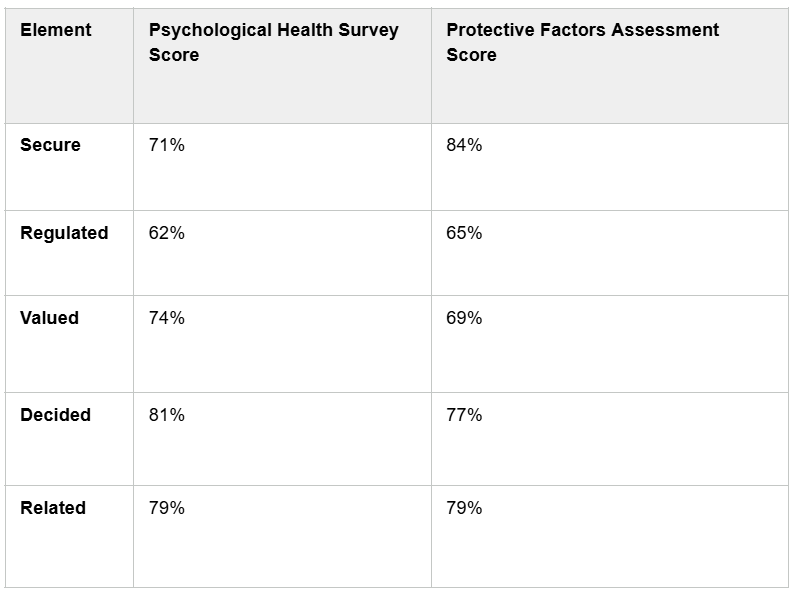
Baseline Psychological Health Survey and Protective Factors Assessment at A Moment of Magic using the 5-Elements of Systemic Wellbeing Surveys in the MAP Software, MindArch Health.
The MAP analytics engine isolated a definitive statistical deficit within the data. By cross-referencing low scores with high-leverage protective variables, the software identified a precise Predictive Goal derived from the participant Likert-scale response data to the question stem: "Most of what I do, each day, interests me." The software generated the following institutional strengths-based goal:
Increase Value (Element) by improving Personal Interests (Protective Factor)
Within the salutogenic framework of the model, Personal Interest is defined as having genuine interest and passion for one's activities and pursuits. This state promotes engagement, motivation, and a sense of fulfillment, functioning as a primary cognitive buffer against monotony, apathy, and declining productivity. The baseline data indicated that while the workforce was highly aligned with the macro-mission of the organization, their daily experience was being degraded by operational friction, driving down their perceived sense of individual organizational value.
4.2. Phase 3: Unite and Inquire (Qualitative Inquiry)
To contextualize this statistical target, AMoM convened an internal stakeholder Task Force to manage the "Unite" and "Inquire" phases. Using the MAP software's qualitative framework, the Task Force conducted structured inquiries across four specific vectors: Identifying Opportunities and Strengths; Shared Responsibility and Vulnerability; Adaptability and Continuous Improvement; and Solution-Focused Collaboration.
The qualitative data clarified that workforce engagement was highly dependent on personal alignment. Personnel demonstrated a strong desire to integrate their unique professional and creative passions directly into the organization’s care models. When they perceived that their ideas were actively built upon and implemented by leadership, their sense of value and output increased. Conversely, top-down communication or merely passive listening acted as an experiential detractor. Trust from leadership was explicitly identified as an essential emotional safety net. Cultural hazards common to digital spaces (such as negative communication, dominating voices, and unaddressed peer conflicts) were noted as being amplified by the virtual environment, rapidly eroding trust and psychological safety.
Operationally, the remote nature of the workforce introduced distinct communication barriers. Personnel noted an acute desire for deeper, non-work social connection, indicating that new members and volunteers required deliberate pathways to feel integrated into the organizational community. Furthermore, while the workforce demonstrated high adaptability (having successfully navigated agile workflows and pandemic-era programmatic shifts), macro-level communication platforms were frequently experienced as overwhelming. The data revealed an explicit preference for fewer large-scale virtual assemblies and a higher frequency of smaller, localized team check-ins to maintain alignment while preventing virtual conference fatigue.
Finally, the Task Force conducted an intensive narrative inquiry via "This I Believe" essays to decode the team's underlying value languages. A thematic analysis of these texts isolated five core constructs:
The Alchemy of Small Acts: The belief that back-end, administrative, and quiet tasks are direct structural prerequisites for meaningful care delivery.
The Power of Presence: The understanding that offering complete psychological presence and active listening is a primary mechanism for reducing trauma and isolation.
Purpose Forged in Personal Experience: The systematic deployment of personal history and past medical adversity as an operational asset for empathy.
Healing as an Active Process: The conceptualization of play and connection not as simple recreation, but as a deliberate, evidence-based care intervention.
The Reciprocal Effect: The realization that the act of care delivery concurrently fosters personal development, leadership skills, and peer support for the provider.
A differential analysis highlighted internal tensions regarding how this purpose was operationalized. Staff members varied across distinct spectrum: Micro-Impact (individual interactions) versus Macro-Impact (systemic movement growth), and Tangible Action (logistical execution) versus Intangible Atmosphere (cultivating psychological safety and peace).
The synthesis of these qualitative findings revealed that the team's primary operational deficit was a misallocation of time. Highly trained, mission-driven care professionals were spending significant time on repetitive, uninteresting manual tasks (such as roster management and manual email routing). This administrative burden was actively competing with the activities they found inherently interesting and meaningful, directly undermining the Valued element. The Task Force concluded that to protect personal interest, the organization needed a holistic strategy that combined administrative automation with clear expectations and increased autonomy.
5. Proactive Mental Health Implementation Plan (The 4P's)
To execute the predictive goal, the Task Force designed and structured an institutional intervention across the 4P's Framework, utilizing administrative automation as a structural tool within a broader organizational management strategy.
Policies: AMoM enacted a formal Flexible Work and Focus Time Policy. This structure protected dedicated deep-work blocks, allowing staff members to self-direct their focus toward programmatic innovation, continuous learning, and specialized care design without operational interruptions.
Practices: The organization implemented Interest-Integrated Performance Conversations. Managers received training to transition from standard task-tracking meetings to formal job-crafting frameworks, giving staff the autonomy to proactively shape their responsibilities around their evolving strengths and professional goals.
Programs: The Task Force launched an Administrative SOP and Automation Program. Repetitive, low-interest backend tasks (specifically visit scheduling, volunteer tracking, and standardized hospital correspondence) were systematized through automated workflows within the MAP architecture. This intervention was designed to structurally eliminate administrative burden, allowing staff to reallocate their cognitive energy toward high-interest care delivery.
Concurrently, regular virtual "Check-In Chains" and "Wellness Wednesday" strategies were embedded into Slack to facilitate non-work peer connection.
Places (Virtual Space Optimization): The digital work environment was restructured to include a formal "Showcase & Celebrate" Space. This dedicated internal hub provided a highly visible platform for staff, student leaders, and volunteers to share personal projects, professional achievements, and creative skills, reinforcing a culture of recognition and mutual value.
6. Results
Following the formal establishment of automated procedures and specialized management practices, a multi-week operational test was executed, culminating in a comprehensive population reassessment in late 2025.
6.1. Quantitative Outcomes
Longitudinal data captured through the MAP platform demonstrated a statistically significant improvement in the target domain. Despite navigating a highly complex transition phase, the organization recorded a definitive 11% improvement in workforce psychological health within the Valued element.
Furthermore, the data reflected a profound stabilization of workforce retention. During the initial baseline assessment and early restructuring phase, the organization experienced a period of high operational strain, during which 12 national team members departed. Following the systematic deployment of the 4P's intervention strategy, however, subsequent organizational turnover decreased by 50%, with only two departures recorded among specialized program personnel over the remainder of the study period.
6.2. Qualitative Observations
Post-intervention evaluations by the Task Force confirmed a marked shift in the daily operational climate. The structural reduction of repetitive administrative friction effectively decoupled care providers from low-interest tasks. By reallocating cognitive capacity toward character-based psychosocial care, leadership training, and collaborative care development, team members reported a stronger sense of professional efficacy, role clarity, and institutional validation.
7. Discussion
7.1. Structural Restructuring vs. Individualized Wellness
The outcomes of this intervention support the hypothesis that population-level workforce wellbeing is a direct output of systemic organizational architecture rather than an individual adaptation. Traditional wellness programs frequently rely on individual-level coping strategies (such as mindfulness applications or self-care education), which fail to address the challenges of structural work demands.
The 11% expansion in the Valued score was driven by changing the systemic conditions of work. By automating repetitive administrative tasks and formalizing focus-time policies, AMoM altered the Job Demands-Resources equation. Reducing structural friction allowed the workforce's intrinsic interest in psychosocial care to function as a self-sustaining protective resource.
7.2. Contextual Interpretation of Workforce Restructuring
These organizational changes occurred during a period of continued national program expansion, suggesting that improvements in workforce wellbeing were achieved alongside increasing organizational complexity. The baseline departure of 12 team members represents an important methodological variable. In a proactive population health model, a period of heightened attrition during early systemic shifts often characterizes an organizational re-centering. When an institution utilizes tools like the EQUIP Model to explicitly define its operational expectations, values, and interest pathways, it alters the person-organization fit equation.
The initial turnover alongside organizational growth reflects a natural compositional alignment phase. The remaining core workforce and newly hired employees experienced an environment where role definitions matched personal strengths and interests. This structural alignment explains the subsequent 50% drop in turnover and the marked inflation of psychological health metrics, demonstrating that long-term retention is achieved by embedding role clarity and autonomy into the institutional design.
7.3. The Socioecological Value Loop
This intervention highlights the critical, bi-directional link between care provider wellbeing and care delivery fidelity. As established in pediatric oncology and psychosocial literature, childhood cancer survivors and their family units experience persistent posttraumatic stress hazards, requiring highly stable, emotionally regulated, and cognitively present support ecosystems to achieve posttraumatic growth (Low et al., 2024; Sharp et al., 2021).
When care providers operate under chronic administrative overload and role ambiguity, their capacity to maintain the emotional surplus required for trauma-informed interaction is diminished. By systematically targeting the Valued element and protecting Personal Interests, AMoM built a resilient care apparatus. Fostering workforce health functions directly as a core child-impact strategy, ensuring that the provider possesses the psychological stability required to sustainably deliver high-fidelity psychosocial care to vulnerable populations.
7.4. Strategic Leadership Development and Scalability
A notable outcome of this socioecological approach is its utility as a leadership development mechanism. Because AMoM operates through an extensive network of emerging professionals, student leaders, and volunteers, the introduction of role clarity, structured job crafting, and autonomous focus blocks provided a formal incubator for future non-profit executives.
Systematically engaging staff in data-to-action planning via the Task Force cultivates critical systems-thinking capacities. This operational design positions workforce wellbeing not merely as a maintenance metric, but as an active professional development methodology.
8. Limitations and Future Research
While this study demonstrates a clear positive trajectory, several structural limitations must be acknowledged. First, the sample size (n = 26) reflects a small, specialized national management team, which limits the immediate generalizability of these findings to large-scale clinical institutions. Second, the longitudinal evaluation occurred over a 15-month timeline during a period of organizational growth including newly hired employees; further research is required to evaluate the multi-year stability of these systemic changes.
Importantly, because AMoM’s operational architecture relies heavily on an extensive network of student leaders, chapter presidents, and regional volunteers, a vital future research direction involves scaling the EQUIP Model into volunteer-led frameworks. Future research should evaluate how these automated administrative interventions and job-crafting strategies function when applied directly to unpaid volunteer workforces and distributed student chapters. Insulating these variables will clarify how socioecological wellbeing architectures can optimize retention and leadership development across complex, multi-tiered volunteer delivery models.
9. References
Bakker, A., & De Vries, J. (2020). Job Demands–Resources theory and self-regulation: New explanations and remedies for job burnout. Anxiety, Stress, & Coping, 34(1), 1–21. https://doi.org/10.1080/10615806.2020.1797695
Ballout, S. (2025). Trauma, mental health workforce shortages, and health equity: A crisis in public health. International Journal of Environmental Research and Public Health, 22(4), 620. https://doi.org/10.3390/ijerph22040620
Brown-Kaiser, C., & Vyas, A. (2024). Subjective well-being and burnout among the maternal and child health workforce. Journal of Primary Care & Community Health, 15, 21501319241263443. https://doi.org/10.1177/21501319241263443
Byrne, M. (2024). Digital compassion fatigue as an emerging phenomenon for registered nurses experiencing technostress. Applied Clinical Informatics, 16(3), 708–717. https://doi.org/10.1055/a-2564-8809
Donley, J. (2021). The impact of work environment on job satisfaction. Nurse Leader, 19(6), 585–589. https://doi.org/10.1016/j.mnl.2021.08.009
Frías, C., Samarasinghe, N., Cuzco, C., Koorankot, J., De Juan, A., Rudwan, H., Rahim, H., Zabalegui, A., Tulley, I., Al-Harahsheh, S., Al-Homaiddi, M., Fendt-Newlin, M., & Campbell, J. (2025). Strategies to support the mental health and well-being of health and care workforce: A rapid review of reviews. Frontiers in Medicine, 12, 1530287. https://doi.org/10.3389/fmed.2025.1530287
Garnett, A., Hui, L., Oleynikov, C., & Boamah, S. (2023). Compassion fatigue in healthcare providers: A scoping review. BMC Health Services Research, 23(1), 10356. https://doi.org/10.1186/s12913-023-10356-3
Henriques, J., Luís, S., Rivero, C., Gonçalves, S., Tavares, L., & Marujo, H. (2024). The impact of community resilience, well-being, and community attachment on human service workers’ burnout. Journal of Social Work, 24(3), 322–338. https://doi.org/10.1177/14680173231225113
Imran, U., Ghazwan, M. F., & Firmansyah, F. (2024). The Effect of Recognition and Appreciation on Employee Motivation and Performance. Economics and Digital Business Review. https://doi.org/10.37531/ecotal.v6i1.1890
Kemelgor, B., & Meek, W. (2008). Employee Retention in Growth-Oriented Entrepreneurial Firms: An Exploratory Study. Journal of Small Business Strategy, 19, 55-68.
Kirkland, C., Dill, J., & Karnik, H. (2023). Retention of community health workers in the public health workforce: Public Health Workforce Interests and Needs Survey, 2017 and 2021. American Journal of Public Health, 113(12), e1–e4. https://doi.org/10.2105/ajph.2023.307462
Kmail, Z., Dorcy, K., & Laing, S. (2025). Burnout predictors among direct clinical services health care professionals in community health centers: A cross-sectional study. American Journal of Health Promotion, 40(1), 28–37. https://doi.org/10.1177/08901171251348220
Lee, K. C., Haines, S. L., Gable, K. N., Bruce, S., Kostrzewa, A., Mantione, M., Oliphant, C., Richter, S. K., Wende, H. M., Burrell, A., & Gordy, X. (2025). Exploration of Psychosocial Hazards: Job Demands, Rewards and Recognitions and Autonomy to Address Workforce Well-Being.. American journal of pharmaceutical education, 101459 . https://doi.org/10.1016/j.ajpe.2025.101459
Low, C., Tan, S., Loh, A., Yu, J., Ong, J., Loh, C., Yau, C., Lee, A., & Ho, C. (2024). Post-traumatic stress disorder and symptoms in paediatric cancer survivors and their family nucleus: Systematic review, meta-analysis and meta-regression. BJPsych Open, 10(1), e805. https://doi.org/10.1192/bjo.2024.805
McCall, T., Perkins, K., & Alford, A. (2025). Burnout, belonging, and mental well-being: Predictors of turnover intent among local public health professionals. Journal of Public Health Management and Practice, 32(2), S25–S32. https://doi.org/10.1097/phh.0000000000002274
Mercado, M., Wachter, K., Schuster, R., Mathis, C., Johnson, E., Davis, O., & Johnson-Agbakwu, C. (2022). A cross-sectional analysis of factors associated with stress, burnout and turnover intention among healthcare workers during the COVID-19 pandemic in the United States. Health & Social Care in the Community, 30(6), e13712. https://doi.org/10.1111/hsc.13712
Paquin, A., Giroux, A., Radziszewski, S., Lauzier-Jobin, F., Coulombe, S., Houle, J., & Meunier, S. (2025). Trajectories of well-being and burnout among health and social services community workers during the COVID-19 pandemic: A longitudinal study of job demands and resources. Journal of Community Psychology, 53(1), 70052. https://doi.org/10.1002/jcop.70052
Pittman, P., & Meeker, S. (2025). Current approaches to addressing burnout and moral injury: Experiences from four community health centers. Journal of Primary Care & Community Health, 16, 21501319251342103. https://doi.org/10.1177/21501319251342103
Rahman, R., Ross, A., Huang, D., Kirkbride, G., Chesna, S., & Rosenblatt, C. (2022). Predictors of burnout, compassion fatigue, and compassion satisfaction experienced by community health workers offering maternal and infant services in New York State. Journal of Community Psychology, 50(8), 22967. https://doi.org/10.1002/jcop.22967
Sharp, K., Tillery, R., Long, A., Wang, F., Pan, H., & Phipps, S. (2021). Trajectories of resilience and posttraumatic stress in childhood cancer: Consistency of child and parent outcomes. Health Psychology, 40(11), 812–822. https://doi.org/10.1037/hea0001132
Sonnentag, S., Tay, L., & Shoshan, H. (2023). A review on health and well-being at work: More than stressors and strains. Personnel Psychology, 76(2), 12572. https://doi.org/10.1111/peps.12572
Wilches, N. (2022). The 5-elements of systemic wellbeing framework: A conceptual model for preventive mental health. MindArch Health.
Wilches, N. (2023). The EQUIP model: A socioecological framework for applied preventive mental health. MindArch Health.
Wilches, N. (2024a, August). Case study: Enhancing wellbeing for childhood cancer survivors through a socioecological approach. MindArch Health Wellbeing Series, Issue (2), 1–9.
Wilches, N. (2024b, October). Examining the mental and behavioral health vulnerabilities of child cancer survivors. A Moment of Magic Foundation.
Wrzesniewski, A., & Dutton, J. E. (2001). Crafting a job: Revisioning employees as active crafters of their work. Academy of Management Review, 26(2), 179–201. https://doi.org/10.5465/amr.2001.4378011
Yang, T., Jiang, X., & Cheng, H. (2022). Employee Recognition, Task Performance, and OCB: Mediated and Moderated by Pride. Sustainability. https://doi.org/10.3390/su14031631
